The Campine Chicken
The Campine is an ancient breed of domestic chicken originating from the Campine (Kempen) region of north-eastern Belgium and south-eastern Netherlands. Known locally as the Kempisch Hoen, it is a "Continental" class bird closely related to the Dutch Chaamse Hoen.
History & Origins:
- Ancient Roots: Legend suggests Julius Caesar took these birds from Belgium after his conquests. In the 16th century, naturalist Aldrovandus noted they likely descended from Turkish fowls.
- Relationship with the Braekel: Historically, the Campine was a smaller, lighter version of the Braekel (weighing roughly 1.2 kg less). While the larger Braekel thrived on the rich clay soil of Flanders, the smaller Campine adapted to the less fertile Kempen district.
- Breed Standards: The breeds were officially separated in 1884, with the Campine gaining its own standard in 1904.
- They were briefly reunited as the "Kempisch-Braekel" in the 1920s.
- By 1962, the Campine type was considered "disappeared" in Belgium, and the national name was changed to Brakelhoen.
- Global Importation:
- England (1899): The British bred the Campine into a distinct bird, standardizing the unique "hen-feathering" in males.
- North America: First imported in 1893 but initially failed to gain popularity. They were re-imported in 1907 and officially added to the APA Standard of Perfection in 1914.
- Color Varieties:
- Silver: White head/neck; body barred with beetle-green black on white ground.
- Gold: Gold head/neck; body barred with beetle-green black on rich gold ground.
- Comb & Face: Large red single comb (may flop to one side); red wattles; red face.
- Earlobes: Pure white.
- Legs & Skin: Dark blue/slate legs; white skin.
- Plumage: Both sexes share the same color pattern (Hen-feathering in cocks).
- Standard Cock: 5.9 – 6.0 lbs | Standard Hen: 4.0 – 5.1 lbs
- Bantam Rooster: 1.5 lbs | Bantam Hen: 1.3 lbs
- Behavior: Active, inquisitive, and "flighty." They are known as excellent foragers and "clowns" of the poultry world.
- Handling: Friendly but not "cuddly"; they generally do not enjoy being held.
- Hardiness: Opinions vary; while some sources call them hardy and cold-tolerant, their large combs are prone to frostbite. They generally prefer warmer climates and do well in free-range environments.
- Flock Dynamics: Best suited for mixed flocks of non-assertive breeds, as their small size may lead to being bullied by larger birds.
- Eggs: Primarily kept for showing today, but historically a reliable "everyday layer." They produce 140–200 medium-to-large white eggs per year. They are non-broody.
- Commercial History: Used as a forerunner to modern systems, particularly for rapid feathering when crossed with Malines chickens.
- Hen-Feathering: Campine roosters lack the typical long sickle feathers of other breeds, possessing plumage identical to hens. This trait is genetically linked to the Sebright bantam.
- Auto-Sexing: The Golden Campine was instrumental in creating the Cambar (the first auto-sexing hybrid) in 1929.
Note: When a Golden male is bred to a Silver female, chicks can be sexed at one day old (Females have a reddish blush; males have gray head spots). - Rarity: Despite their history, they remain one of the rarest domestic chicken breeds.
Physical Characteristics:
The Campine is a small, elegant bird with close-fitting feathers and a distinctive color pattern.
Features:Weight Standards:
Temperament & Husbandry:
Use & Production:
Genetic Significance:
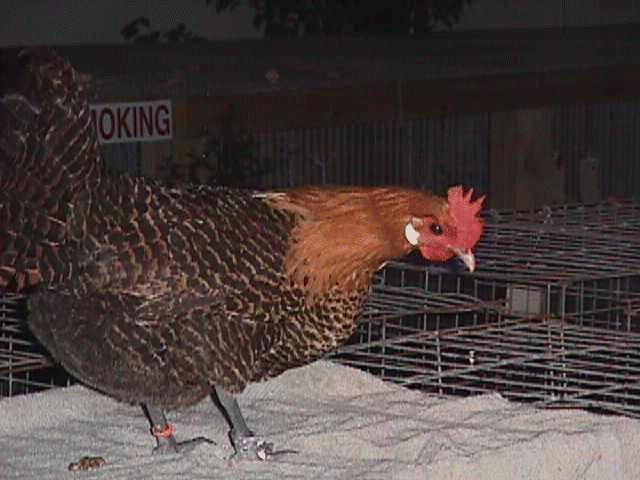
Golden Campine Hen