The Faverolles Chicken Breed
Origin and History
- Origin: The Faverolles is a breed originating from France, specifically named after the village of Faverolles in the Eure-et-Loire region, southwest of Paris.
- Development: The breed was developed in the 1860s in the vicinity of Houdan and Faverolles through the crossbreeding of various breeds, including the Houdan, Brahma, French Rennes, Flemish Cuckoo, Malines, and Dorking, with selection focused on desirable production qualities.
- Naming Note: The singular form of the name is
Faverolles, and the final "s" is silent in French. - Evolution: While initially bred in France as a utility fowl for meat and eggs, the breed was introduced to the UK in 1886. British breeders subsequently altered the breed to meet exhibition standards, resulting in a type with longer, higher raised tail feathers compared to their French and German counterparts.
- Recognition: The breed was considered the best French breed produced in the 1900s. It was introduced to England in 1894, and later, Dr. A.H. Phelps imported them to America in 1901/1902, where the breed gained popularity.
- American Recognition: The American Poultry Association (APA) recognized the Salmon and White varieties in 1914 and 1981, respectively.
Characteristics and Appearance
Physical Traits
- Weights: Cock 8-11 lbs, Hen 6-9.5 lbs.
- Classification: Continental class (The American Poultry Association).
- Physical Traits: Faverolles are medium-sized with deep, compact bodies. They possess distinctive features such as a beard, muffs, feathered feet, and five toes per foot. They also have a red single comb.
- Coloration: The most common color is Salmon. Females (Salmon) exhibit plumage that is mainly brown and creamy white, while males are darker, featuring black, brown, and straw-colored feathers. The White variety also exists.
- Facial Features: The males display a lighter Golden Duckwing appearance, and the females a lighter Wheaten appearance.
- Beak and Eyes: The Salmon variety features a horn, while the White variety has a white beak. Eyes are typically reddish bay.
- Temperament: Faverolles are renowned for their extreme docility and gentleness, making them excellent pets, especially for children. They are calm, energetic, adaptable, and curious, generally getting along well with people of all ages.
- Social Behavior: Due to their gentle nature, they tend to be easily bullied in mixed flocks, thriving best when kept in groups of Faverolles or with docile breeds like the Sussex or Brahma. They are alert and will vocally warn of approaching strange animals.
Production and Utility
Dual Purpose
- Dual Purpose: Historically bred for both meat and eggs, Faverolles remain highly regarded today as excellent layer chickens and fine meat birds.
- Egg Production: They are excellent layer birds, often producing 180 to 240 eggs annually, with hens typically laying about four to five eggs per week. They are known for being good winter layers. Eggs are generally medium to large, often exhibiting a light brown to pinkish tint.
- Meat Quality: The breed produces fine broilers and roasters, combining excellent egg-laying ability with fine flesh qualities.
- Market Role: They were historically crucial in producing eggs for the Paris market during the early 20th century.
Care and Health Management
Housing Requirements
- Housing: Faverolles require a dry, draft-free, and well-ventilated coop with adequate square footage per bird to protect their feathered feet. They need a secure run to deter predators.
- Environmental Concerns: They are susceptible to respiratory distress, gagging, or lethargy in warm, damp, or unventilated conditions, as well as heat stress due to their heavy feathering.
- Foot and Leg Care: Due to their feathered feet, they are prone to issues like scaly leg mites, which cause crusty scales, and foot infections from accumulated mud. Regular checks for injuries to the fifth toe/toenail are necessary.
- Chicks Care: Chicks must be protected from issues like "pasty butt" (dried stool blocking the vent), requiring gentle cleaning.
- Parasite Management: Care must be taken to manage parasites and mud, ensuring dry, clean bedding to prevent foot infections and issues with lice or worms.
- Nutrition: They require standard, high-quality layer feed (17% or higher) to maintain their thick feathering. They also need consistent, high-protein feed.
Lifespan and Maturity
- Lifespan: With proper care, Faverolles typically have a lifespan of 5 to 8 years, with many surviving up to 7 years.
- Maturity: They reach maturity slowly, typically starting to lay eggs around 20–24 weeks of age.
- Production Cycle: Egg production usually begins to decline after three years, although hens can continue to live as pets.
Conclusion
The Faverolles breed offers a delightful combination of docile temperament, fine meat and egg production, and striking appearance, making them a highly rewarding and gentle addition to any poultry keeping endeavor. With careful attention to their specific care needs, they continue to thrive as prized domestic fowl.
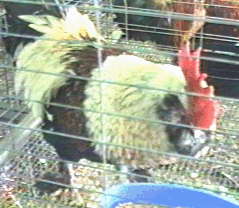
Salmon Faverolle Cock