The Houdan: A Heritage Breed with Five Toes
The Houdan, or Poule de Houdan, is one of France’s oldest and most recognizable poultry breeds. Named after its town of origin in the Yvelines département west of Paris, this bird is a member of the crested chicken group and is celebrated for its quirky appearance, gentle temperament, and historical status as a premier table bird.
History and Origins
While the exact origins of the Houdan are lost to time, it is believed to be centuries old.
- Ancient Ancestry: Some historians trace the breed back to the five-toed fowls mentioned by Roman author Columella (4 AD – 70 AD). It likely resulted from crossing the common five-toed fowls of France and Belgium with the crested races of Caux, Normandy.
- Refinement: In the 1800s, the breed was likely "improved" by crossing it with the Crevecoeur, Dorking, and Polish breeds to increase size and production.
- Global Spread: The Houdan arrived in England in 1850 and North America in 1865. It was officially recognized in the first edition of the American Poultry Association (APA) Standard of Perfection in 1874.
- Conservation Status: Once a staple of French commercial markets, the breed is now rare. The Livestock Conservancy lists its status as "Threatened" or "Critical."
Distinctive Physical Characteristics
The Houdan is instantly identifiable by a combination of traits rarely seen together in a single breed.
- Crest & Head Features a large "Polish-style" crest, a full beard, and muffs. It has a vaulted skull and wide, cavernous nostrils.
- The Comb Historically "leaf-shaped" or like a butterfly with open wings. In the US and Canada, the standard is a V-shape.
- Five Toes Unlike the standard four, Houdans possess a fifth toe on each foot (a trait shared with the Dorking).
- Color Varieties
- Mottled: The most common; black with white spotting/spangles.
- White: Developed in the US by crossing Mottled Houdans with White Polish (recognized 1914).
- General Build Medium-sized, long, compact, and well-proportioned with white skin and pinkish-white shanks.
- Weights: The Cock weighs about 7.0 – 8.0 lbs and the hen usually weighs about 5.5 – 6.5 lbs.
Utility and Production
Historically a dual-purpose fowl, the Houdan was once a principal meat breed in France, even achieving the prestigious "Label Rouge" certification for taste.
- Egg Laying: They are excellent layers of large white eggs, typically producing between 150 and 230 eggs per year. They are noted for being reliable winter layers.
- Broodiness: Generally considered "non-setters" (non-broody), though this can vary by strain.
- Meat Quality: They fatten easily and produce fine-grained meat with less offal than many other heavy breeds.
- Breeding: Roosters are known to be "ardent" lovers, requiring a large flock of hens (roughly 8:1 ratio) to maintain high fertility rates.
Temperament and Care
Houdans are famous for their exceptionally gentle and docile disposition, making them ideal pets for families and children.
- Environmental Needs: They prefer dry, sunny climates. Because of their large crests, they are prone to frostbite if their feathers get wet and freeze in winter. They require shade in excessive heat.
- Safety & Vision: Their exuberant crests often block their vision, making them "feather blind." This makes them vulnerable to predators; therefore, unsupervised free-ranging is not recommended unless their crests are trimmed.
- Flock Dynamics: Due to their sweet nature, they should be kept with other non-aggressive breeds to prevent them from being "picked on."
- Maintenance: Owners should perform regular mite checks within the dense beard and crest feathers.
Houdan vs. Polish: What’s the Difference?
Though often confused with the Polish chicken, the Houdan is distinct:
- Toes: Houdans have 5; Polish have 4.
- Weight: Houdans are significantly heavier (up to 8 lbs) compared to the lighter, ornamental Polish (approx. 6 lbs).
- Purpose: Houdans are a heritage dual-purpose breed (meat/eggs), while Polish are primarily ornamental.
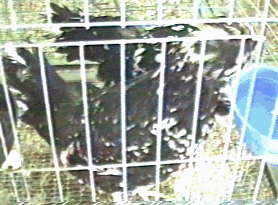
Mottled Houdan Pullet