Araucanas: The Only Chicken With Ear Tufts
by Dennis HawkinsThe Araucana is a rare and visually striking breed of domestic chicken originating from the Araucanía region of Chile. Often called the "Gallina Mapuche" in its homeland, it is world-renowned for being one of the few breeds to lay naturally blue-shelled eggs.
The araucana breed has several distinct features that no other breed has. The most prominent features are its rumplessness, ear whiskers, and its ability to lay blue shelled eggs. The birds also have a pea comb and virtually no wattles. The araucana breed is from South America near northern Chile and was first successfully bred in the US in the 1930's.
Rumplessness means that the birds, both male and female, do not possess a tail. It is not simply a bird with missing tail feathers, rather, the entire coccyx is missing. The rumplessness of the araucana is unique in that it is the standard trait of the breed rather than being a one of a kind birth defect.
The ear whiskers that are present on the breed are tufts of feathers that grow from the ear lobe region on the side of the bird's head. These feather tufts will sometimes grow rearward and touch each other to form what looks like a complete ring around the bird's head. More commonly, the tufts simply grow straight out from the bird's head and resemble miniature feather dusters stuck in the birds ears.
The ear whisker trait should not be confused with beards found on other breeds. Ameraucanas, houdans, faverolles, polish, and crevecoeurs have beards. Although their beards may resemble small ear tufts, they are not. Araucanas do not have beards. The Ameraucana chicken also lays blue or green eggs and is derived from the araucana. However, unlike the ameraucana, the araucana has no extra feathering under its chin.
The blue egg laying characteristic is shared only by the ameraucana breed. The araucana is very difficult to breed, therefore, in the 1970's, breeders came up with the ameraucana. The ameraucana is an easy to breed derivative of the araucana and is also capable of laying blue eggs.
Because of genetic contamination, many araucana and ameraucana birds do not lay sky-blue colored eggs. Instead, the colors range from aqua-blue to green to brown. The pure blooded araucana's eggs will be solid blue and the shell color will permeate through the entire shell. This is unlike brown-shelled eggs where the coloring is just on the surface of the egg. By hatching only eggs that are sky-blue and have the blue color all the way through the shell, the poultry breeder can be more certain of hatching quality offspring. Brown or green eggs should not be hatched as birds who lay those eggs possess a high degree of genetic contamination.
The araucana first gained popularity in this country primarily because of its blue egg laying characteristic. Unfortunately, most hatcheries that sell "araucana" chicks are actually selling a mixed breed that is often referred to as an "Easter Egg Chicken". Because the blue egg laying quality is the result of a dominant gene, other breeds that are mixed with the araucana will usually result in blue or green egg laying offspring. Currently, there are only a handful of hatcheries in this country that sell "pure" araucanas.
History and Origins
The early history of the Araucana is shrouded in mystery and academic debate. Some theories suggest a pre-Columbian, possibly Polynesian, origin based on chicken bones found in south-central Chile, though modern genetic studies offer conflicting evidence.
- Discovery: Spanish aviculturist Salvador Castelló first described the birds in Chile in 1914. He introduced them to the global poultry community at the 1921 World’s Poultry Congress.
- Scientific Recognition: Initially thought to be a new species (*Gallus inauris*), they were later correctly identified as *Gallus gallus domesticus*.
- Publicity: Appeared in the April 1927 issue of The National Geographic Magazine and again in the September 1948 issue.
- Introduction to North America: The first significant import to the U.S. occurred in 1924 by the Pratt Experiment Farm.
- Standardization: The American Poultry Association (APA) officially recognized the breed in 1976.
Physical Characteristics
- Egg Color: Blue to Blue-Green
- Comb Type: Pea Comb (Frostbite resistant)
- Skin Color: White
- Key Traits: Rumpless, Ear Tufts, Blue Eggs
- Unique Traits: ear tufts (feathers protruding from the sides of the neck) and rumplessness (the complete absence of a tail and tailbone).
Breeding
- APA Accepted Varieties:
- Rumplessness: Required.
- Tufted: Required.
- Allowed Colors: Black, White, Black Breasted Red, Silver Duckwing, and Golden Duckwing.
- Breeding Mechanics A regular hen with a tail will use her coccyx to pull her tail feathers up and out of the way while mating with a rooster. This facilitates
rooster sperm entering the hen's cloaca. Since Araucana hens still have tail feathers covering her backside, but no coccyx with which to pull them up and out of the way, natural
breeding is exceptionally difficult. Successful breeders will use one of two methods to facilitate conception:
- Artificial Insemination This guarantees that the hen has been properly fertilized.
- Mechanical Exposure This is where the vent is permanently exposed by cutting away all of the feathers that cover it. This will work, but has the disadvantage of attracting other chickens that will peck at her vent and, in some cases, disembowel her.
- Lethal Genes: Both ear tufts and rumplessness are caused by autosomal dominant lethal alleles. This makes breeding Araucanas exceptionally difficult; if a chick inherits two copies of the tufted gene, it will die in the shell. Consequently, not all purebred Araucanas will display these traits. The odds of getting a show quality bird is about 1 in 100 eggs set. Assuming you start with two show quality parents, it is genetically impossible to end up with more than half the offspring being true araucana. Actually, about one forth of the hatching chicks will be still-born (dead in the shell). They will completely form and can even be heard peeping from inside the shell, but they will die shortly before it is time to hatch. Another forth of the hatching eggs will not yield chicks with ear tufts. This leaves half of the chicks with ear tufts, but by the time you separate out the ones that have tails and the ones with poorly formed or unbalanced ear tufts, you will be lucky to have just one show quality bird remaining.
Weights
The Araucana is a medium-sized breed with a "meaty" carcass.
- Standard Rooster: 5 – 7 lbs
- Standard Hen: 4 – 5 lbs
Egg Production
Araucanas are reliable layers of medium-sized, pastel blue or blue-green eggs.
- Annual Production: 150 – 250 eggs per year (approx. 3 eggs per week).
- Time to First Egg: They are considered "late bloomers." While some may start at 18–20 weeks, most begin laying between 24 and 28 weeks (6 months).
- Egg Facts: The blue color is due to the *oocyan* gene. Unlike brown eggs, the blue pigment goes all the way through the shell.
Temperament and Lifespan
- Rooster Aggressiveness: Generally, Araucana roosters have a mild, calm, and curious temperament. They are considered friendly and can make great pets. However, like any breed, individual roosters may become territorial or protective of their hens during breeding season.
- Hen Temperament: Hens are typically docile, active, and "wild at heart," meaning they are excellent foragers.
- Lifespan: They are a hardy heritage breed with a typical lifespan of 8+ years. With excellent care, some individuals have been known to reach 12 to 14 years of age.
- Hardiness: They do well in both summer and winter.
The Araucana remains a "breeder's bird" due to the genetic challenges associated with their appearance. Despite these difficulties, they are prized for their unique beauty, high-quality eggs, and engaging personalities.
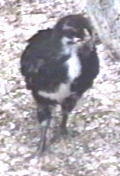
Black Araucana Chick

Black Araucana Chick
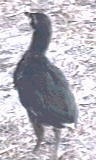
Black Araucana Chick
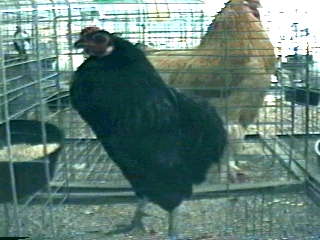
Black Araucana Cockerel
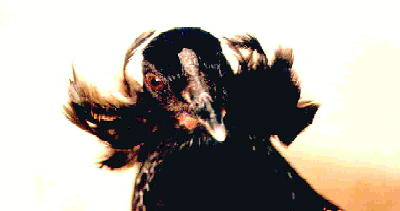
Photo of "Ms. Wings"