Castilian: Spain’s Ancient Heritage Breed
By Dennis HawkinsThe Castilian chicken, historically known as the Gallina Castellana Negra or simply the Black Castilian, is one of the oldest and most resilient European chicken breeds. Celebrated for its rich history, striking appearance, and exceptional foraging capabilities, this Mediterranean heritage fowl has weathered centuries of agricultural shifts. Today, it stands as a prized possession for poultry preservationists and sustainable homesteaders alike.
History and Origins: The Chicken of Royalty and Explorers
The roots of the Castilian breed stretch back to the Moorish occupation of the Iberian Peninsula, during which Arab invaders introduced the birds to Al-Andalus. This lineage earned them the historical nicknames of "Moorish fowl" or moruna. While initially widespread across southern and central Spain — thriving primarily throughout Old Castile — the breed was virtually unknown in the northern part of the Iberian Peninsula until the late 19th century.
Throughout its long history, the black chickens of Spain were recognized by various regional names, including:
- The Zamorana (in the province of Zamora)
- The Leonesa (in the province of León)
- The Andaluza Negra (in Andalucia)
- The Jerezana (in the area of Jerez de la Frontera)
Over time, these regional variants were selected and unified into a single recognized breed.
Breed Trivia
The Black Castilian is famously tied to the dawn of global exploration. It is highly documented as the favorite breed of Queen Isabella "the Catholic." Because of her royal favor, Christopher Columbus transported these very chickens to the Americas in the 15th century. Later, during the reign of Spanish King Charles I, the breed was introduced to Flanders, ultimately influencing many of the black-colored chicken breeds found across Europe today. Furthermore, because of a powerful physical resemblance, the Castilian is strongly suspected of being the direct ancestor of the popular Minorca breed.
The Fight Against Extinction
In the first half of the 20th century, the Castilian was one of Spain’s most commercially exploited chicken breeds, revered for mass egg production. A formal breed standard was drawn up in 1926 by D. Enrique P. de Villamil and officially approved in 1930.
However, the advent of battery farming and the introduction of highly specialized, imported industrial hybrids — specifically the White Leghorn — nearly wiped out the breed. According to data from the Food and Agriculture Organization (FAO), the Black Castilian was pushed to the absolute edge of extinction.
Rescue operations began in 1975 under the Animal Genetic Improvement Department of Spain's National Institute for Agricultural and Food Research and Technology (INIA). Starting with a dangerously small foundation of just two birds from Córdoba and ten from Mérida, the population slowly recovered. By 2009, conservation numbers climbed into the hundreds at INIA's El Encín experimental station (which includes a frozen sperm bank established in 2009) and around 1,000 birds at the University of Valladolid at Soria.
Though left off the 2008 official indigenous Spanish breeds list, a ministerial order officially added the breed back on March 4, 2010. Today, the breeders' association GANECA (National Association of Breeders of Select Pure Spanish Castellana Chickens) maintains the official flock-book. The breed remains listed in the Official Catalog of Livestock Breeds of Spain as an indigenous breed at risk of extinction. The conservation status is classified as "at risk/vulnerable," maintaining a stabilized population of approximately 2,200 birds.
Physical Characteristics and Identification
The Castilian is a lightweight, dynamic, and proud Mediterranean-type fowl. To differentiate this breed from other black or Mediterranean chickens, look for its specific combination of white earlobes, slate legs, and lack of facial feathering.
- Plumage: Entirely glossy black with an intense, iridescent blue-green sheen that is particularly pronounced in the roosters.
- Skin Color: Tinted white.
- Comb, Face, & Wattles: Deep, vibrant red. The comb is a single variety featuring 5 or 6 well-defined, sharp serrations.
- Earlobes: Striking, pure white, and perfectly smooth, creating a sharp contrast against the red face and black feathers.
- Beak: Medium, stout, and colored black or dark horn.
- Eyes: Large and expressive, with an orange to reddish-brown iris.
- Legs & Feet: Dark slate in color, completely free of feathers, ending in four straight toes with white or black nails.
- Defects to Avoid: When breeding to standard, birds exhibiting any white, red, or brown in the plumage must be excluded. Feathered shanks, a "squirrel tail" (tail held at or past a 90-degree angle/leaning forward), or a female with a perfectly straight or excessively lopping comb are considered serious faults.
Breed Weights and Sizing
The Castilian is a medium-sized, lightly built bird designed for agility rather than meat production.
| Sex | Average Weight | Standard Ring Size | Comb Characteristics |
|---|---|---|---|
| Rooster (Cock) | 6.2 – 6.6 lbs | 18 mm | Medium size, smooth, perfectly straight, with the posterior lobe held slightly away from the neck. |
| Hen | ~5.1 lbs | 16 mm | Smaller stature; the rear half of the comb characteristically lops over to one side without covering the eye. |
Note1: The breed has not currently been admitted to the American Poultry Association (APA) standard.
*Note2: Ring Size refers to the diameter of the bird's leg band.
Egg Production and Lifespan
While the Castilian is a slow-maturing heritage breed compared to modern industrial hybrids, it remains an exceptional utility bird for modern homesteads.
- Time Until First Egg: Hens are relatively precocious, starting to lay at 4 to 5 months (20 to 24 weeks) of age.
- Annual Egg Yield: An excellent producer, a healthy hen will lay 200 to 225 eggs per year (historically recorded up to 240 under optimal conditions).
- Egg Quality: The eggs are medium-to-large in size, weighing an average of 60 grams, and feature a pure, chalky-white shell.
- Lifespan: True to its rustic heritage, with proper care and protection from predators, the Castilian chicken shares the typical lifespan of resilient heritage breeds, averaging 5 to 8 years.
Temperament and Behavioral Traits
The Castilian is an independent, highly active, and vocal breed. They are the antithesis of a "lap chicken." If you are looking for a cuddly pet, this breed is not a good fit; however, if you want a self-sufficient, predator-savvy worker, they excel.
- Flighty and Skittish: They generally dislike being handled or held. Their first instinct when approached by humans or threats is to flee rather than fight.
- Expert Foragers and Garden Helpers: They possess an innate, high-energy drive to scratch and scour the ground for seeds, insects, and worms. They are highly regarded for their soil-turning and compost-turning abilities, which acts as a natural pest control system. They happily consume household vegetable scraps, fish, and red meat, and their high-nitrogen manure serves as an excellent compost activator.
- Confinement Intolerance: These birds do not tolerate small coops or tight runs. They require large, expansive free-range environments to thrive.
- Skilled Flyers: Due to their lightweight bodies, they are powerful flyers. They can easily clear standard fences and will actively choose to roost high up in trees at night to stay safe from predators.
Genetically adapted to the harsh Mediterranean continental climates of central Spain, the Castilian possesses remarkable climate resilience. They can easily withstand extreme temperatures ranging from freezing winter lows of -15°C (5°F) to blazing summer highs of +40°C (104°F).
Rooster Temperament and Flock Management
Castilian roosters are highly alert, vigorous, and fiercely protective of their hens. Because they are an active, primitive breed, mature roosters can develop territorial aggression and may attempt to challenge human owners to establish dominance.
Recognizing Warning Signs
A Castilian rooster will rarely attack without giving natural behavioral cues first:
- The Stare: He will pace nervously while locking his side-eye directly onto you.
- Puffing Up: He will fluff his neck hackles and body feathers to appear larger.
- The Mating/Dominance Dance: He will drop one wing to the ground, lower his head, and sidle or circle around you.
Managing Aggressive Behavior
To safely manage an aggressive rooster, always wear protective clothing (sturdy boots, long pants, and heavy gloves) and employ humane training methods to establish your position as the leader:
- Stand Your Ground: Never back down, run, or turn your back on a charging rooster. This signals to him that he has successfully chased you away. Instead, walk boldly and directly toward him to force his retreat.
- The "Carry" Method: When the rooster acts up, calmly pick him up and hold his body securely under your arm. Walk around the yard with him for a period, parading him in front of his hens. This behavior humbles his ego and reinforces your status as the alpha flock member without harming him.
- Submissive Posturing: Alternatively, you can gently but firmly pin him to the ground in front of you, placing a hand between his shoulder blades and holding his head down until he stops struggling and relaxes.
- Minimize Triggers: Avoid sudden, jerky movements inside the coop. Be mindful that roosters can be startled or triggered by bright neon clothing or brightly colored utility objects like neon buckets.
- Use Barriers: Keep a long-handled tool, such as a broom or stick, on hand to act as a physical shield to gently shoo him away.
If a rooster remains dangerously aggressive despite consistent training, particularly around children, rehoming him to a expansive farm environment is the safest option.
Genetic Science and Biodiversity
The preservation of the Black Castilian is highly valued by geneticists. Selective breeding by massive poultry conglomerates prioritizes extreme meat and egg yields at the cost of immune system diversity. Researchers note that in the event of a major global avian pandemic, highly specialized commercial hybrids are often the first to succumb due to compromised defenses. The rustic Castilian retains vital, robust genetic biodiversity.
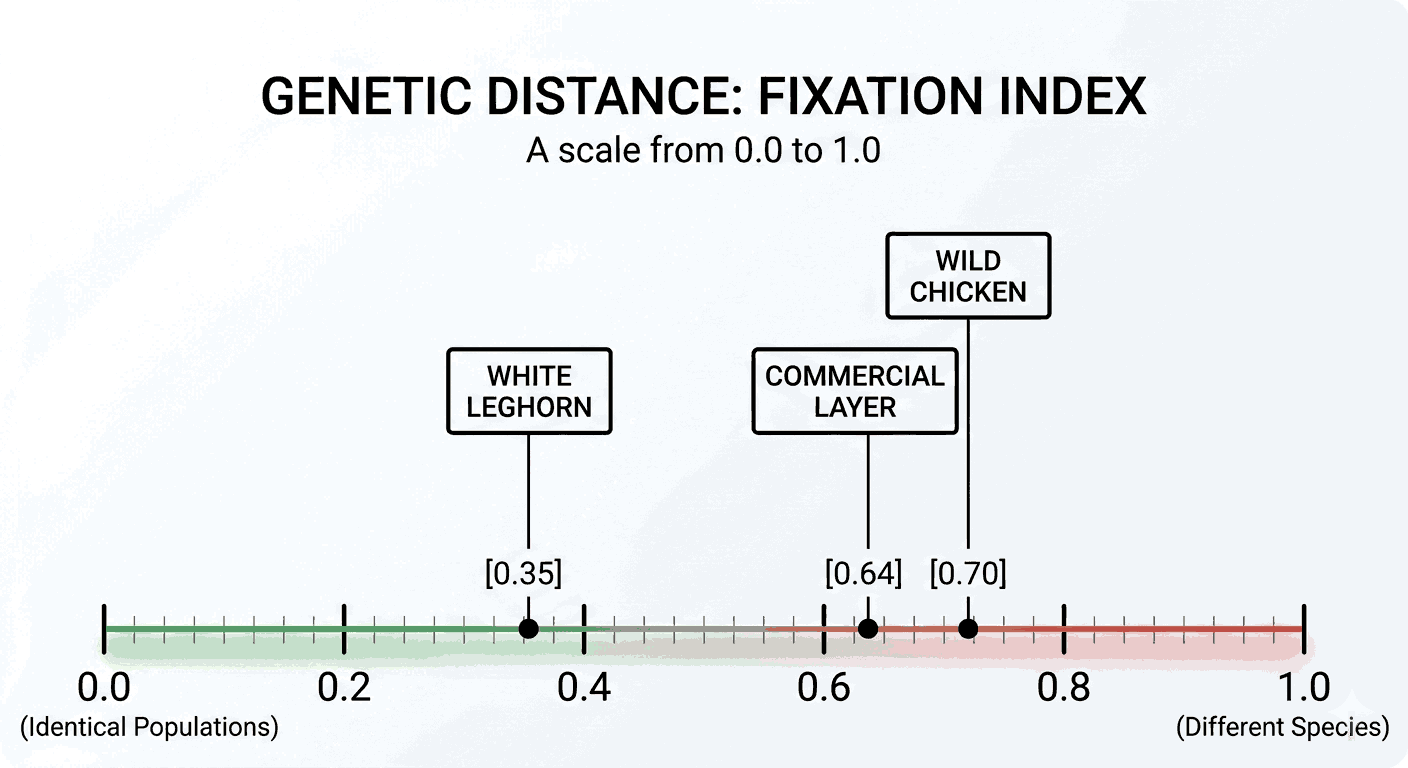
Genetic distance studies conducted by Spain's National Institute of Agrarian Research reveal the breed's distinct genetic mapping through its Fixation Index (measured from 0 to 1, where 0 is identical and 1 is a separate species):
- Distance to White Leghorn: 0.35
- Distance to Commercial White Egg Layer: 0.64
- Distance to Wild Chicken (Red Junglefowl): 0.70
Genetic Color Markers
The uniform jet-black plumage of the Castilian is driven by the pigment eumelanin, which is housed in elongated cellular vesicles called melanosomes. The breed carries the allele E (Extended black) from the extension gene locus series, completely suppressing patterns in favor of solid black. This is further intensified by the melanotic (Ml) dominant mutation. Their signature dark slate leg color is a result of the sex-linked normal dermal melanin gene (id+) interacting perfectly with the normal white skin gene (W+).
Ultimately, the Black Castilian chicken stands as a living testament to poultry history, balancing royal heritage with rugged, Mediterranean resourcefulness. By choosing to raise this vulnerable breed, modern homesteaders gain not only a highly efficient, predator-savvy egg producer, but also a valuable partner in genetic conservation. Preserving the Black Castilian ensures that its remarkable climate resilience and ancient bloodline continue to enrich the global poultry community for generations to come.