Onagadori: Japan’s Living National Treasure
Contributed by Marc King and Dennis HawkinsThe Onagadori (historically written as 尾長鳥, translating roughly to "Honourable Fowl" or "Long-Tailed Fowl") is an extraordinary phenomenon of selective animal breeding. Hailing from Japan, this historic and highly revered ornamental breed is world-famous for a unique genetic mutation that allows the roosters' tail feathers to grow continuously throughout their lives without molting.
Designated a Special National Natural Treasure by the Japanese government in 1952, the Onagadori represents the absolute pinnacle of intensive poultry husbandry, demanding a level of dedication and specialized care unmatched by almost any other breed.
History and Origins: From Samurai Crests to National Treasures
In Japanese literature, the exact structural origins of the Onagadori are not definitively documented. However, cultural historians and poultry geneticists believe that the breed emerged through a series of radical mutations from an ancient Japanese breed called the Shokoku during the middle of the Edo Period (1600–1868). The Shokoku produced a breed called the Shinoharato which in turn produced a breed called the Nagaodori which finally produced the Onagadori.
The Legends of Tosa Province
The development of the breed is deeply intertwined with Japanese feudal history and tax exemption lore:
- The Shogun's Feathers (c. 1655): Oral history dictates that the territorial Prince (or Shogun) Yamanouchi of the Tosa Province — located in the Kochi Prefecture on the southern peninsula of Shikoku island — wished to honor the Emperor Tenno during special state occasions. He commanded that the helmets and spears of his samurai soldiers be adorned with exceptionally long, sweeping rooster feathers.
- The Imperial Tax Loophole: To secure a steady supply of these ornamental plumes, the Prince decreed that any peasant farmer who successfully bred chickens with elongated feathers and delivered them to the castle would be entirely exempt from land taxes. This powerful economic incentive kicked off centuries of highly focused, competitive breeding for feather length. Authentic helmets and spears from this period adorned with original long feathers can still be viewed in Japanese museums today.
- The Breeding Breakthrough: A major breakthrough in tail-growth genetics was achieved by a master breeder named Mr. Takeichi Riuemon in the village of Shinohara, Kochi Prefecture. To honor his monumental success, the birds from this era were initially called "Shinoharato." As the tails grew longer, they were renamed "Nagaodori" (long-tailed bird), and later simply referred to as "Tosa" after the province itself. Today, a stone memorial monument dedicated to Takeichi still stands on the street heading toward the city of Nangoku to honor his contribution to avian history.
Academic Recognition and Global Impact
In 1857, during the fourth year of the Ansei era, the Japanese botanist Koyu Nishimura published Sketches and Thoughts. This book formally detailed the biological phenomenon of the Onagadori's non-molting, continuous tail growth, making the breed famous among the common people of Japan.
The Onagadori reached its fully distinct, refined "thoroughbred" status during the Taisho Period (1912–1926). It was during this golden era of breeding that individual rooster tails began reaching lengths of 20 feet or more. The breed later served as a primary genetic ancestor in the development of the popular German Phoenix breed.
The Genetics of Non-Molting Plumage
The defining trademark of the Onagadori is its biological refusal to molt. While all standard chicken breeds shed and replace their entire plumage annually, the Onagadori rooster carries a rare, recessive combination of genes—most notably the "nm" (non-molting) gene.
How the Tail Grows
- The Roosters: Under pristine environmental conditions and meticulous animal husbandry, the primary sickle feathers, lesser sickles, and tail coverts do not molt. Instead, they grow indefinitely for the natural life of the bird. However, a small portion of the tail remains partially wild-type; some roosters may partially molt select sickle feathers each year, or shed individual feathers every second or third year.
- The Hens: The unique non-molting gene is only visually expressed in the males. Onagadori hens molt completely normally every autumn, just like standard domestic chickens.
- Body Molting: On both roosters and hens, the feathers covering all other parts of the body (including the head, breast, back, and legs) molt on a standard annual schedule.
Physical Characteristics and Identification
The Onagadori is a light, elegant, and gracefully built bird of distinct Mediterranean-Asiatic carriage. To accurately differentiate an authentic Onagadori from a lookalike breed like the Phoenix, breeders look at specific leg and color combinations.
- Skin Color: The underlying skin is standard pale or white.
- Headgear: Both sexes feature a bright red single comb, though the rooster's comb is significantly larger and stands perfectly erect. They have matching bright red wattles and smooth, distinct white earlobes.
- Legs and Feet: The shanks and toes are completely clean (free of feathering). The accepted leg color is strictly dictated by the plumage variety:
- Black-Breasted Variations: Must have willow (greenish-yellow) legs.
- White Variations: Must have yellow legs.
- Strict Standard Guardrail: No blue legs are accepted in the official Japanese standard for purebred Onagadoris.
Accepted Color Varieties
The Onagadori is not recognized in the American Poultry Association (APA) Standard of Perfection. However, there are three primary recognized color varieties within the pure breed standard of Japan:
- Black-breasted White (Shirafuji): Often considered the original and purest color variety of the breed. Roosters feature white hackles, saddles, and tails with striking black breasts.
- Black-breasted Red (Akazasa): A striking variety where the rooster's plumage features a classic red/gold duckwing pattern, deep black breast feathers, and flowing black/dark tails.
- White (Hakushoku): A completely solid white variety that retains all the structural and length traits of the standard but features all-white plumage.
Breed Weight Standards
The Onagadori is a lightweight breed designed for high-perch lifestyle balance, ensuring that their body mass does not pull or damage their monumental tails.
- Rooster (Cock): Averages 4.0 to 5.5 lbs.
- Hen: Averages 3.0 to 4.5 lbs.
Growth, Diet, and Egg Production
The Onagadori is strictly an ornamental, exhibition-class heritage breed. They are slow to mature and are incredibly poor choice for meat or commercial egg utility.
- Time Until First Egg: Onagadori pullets (young females) are slow-maturing, generally laying their first eggs between 6 to 7 months (24 to 28 weeks) of age.
- Annual Egg Yield: They are poor, highly seasonal layers. A healthy hen will produce a mere 50 to 100 eggs per year, with the vast majority of production concentrating in a short window during the spring months. Egg production naturally slows down or completely stops during the autumn and winter.
- Egg Characteristics: The eggs are small to medium in size, featuring a shell color that ranges from cream to light tan/brown.
Tracking Laying Readiness
Because Onagadori pullets take up to 28 weeks to lay, you can monitor their readiness via three indicators:
- Reddening Facial Features: The comb and wattles will rapidly swell and shift to a deep, vibrant crimson.
- Pelvic Bone Separation: The pelvic bones below the vent will slowly spread apart to allow eggs to pass. If you can gently fit approximately three fingers between the bones, she is ready.
- The Nesting Squat: She will actively investigate nesting boxes and perform a submissive "squat" posture when a human handler approaches.
Lifespan and the Art of High Husbandry
The Onagadori has an average lifespan of 8 to 15 years, provided they receive elite-tier animal husbandry. Because their tails grow continuously, their longevity and overall health are entirely dependent on their human caretakers.
The Tomaya: Traditional Housing
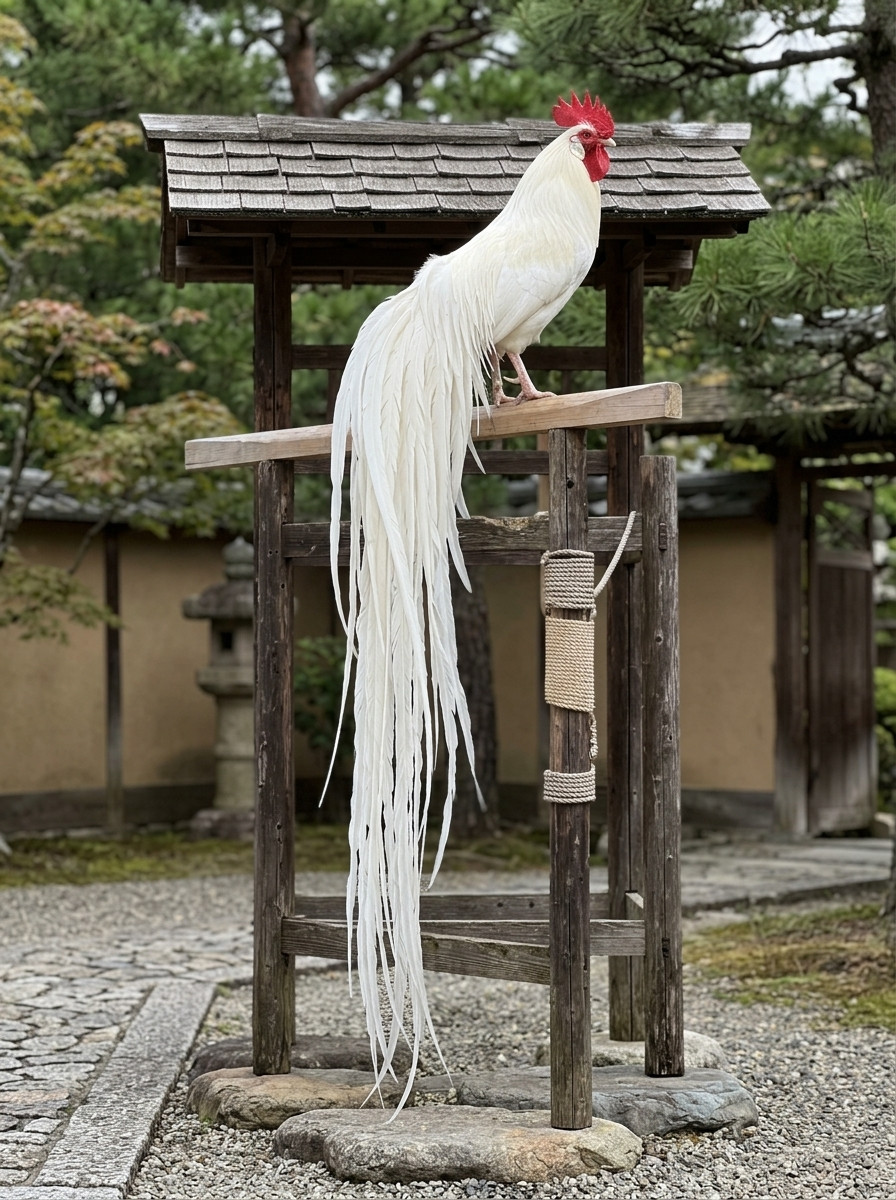
In Japan, breeding roosters are kept in highly specialized, custom-designed housing facilities called Tomaya. These are tall, narrow, vertical enclosures or highly elevated perches designed to keep the rooster safely stationary while allowing his massive tail feathers to hang cleanly down without touching the floor.
Without this extreme cleanliness and elevation, the tail feathers will inevitably drag in mud, moisture, and feces, leading to severe matting, entanglement, feather rot, and fatal bacterial diseases.
High-Protein Dietary Needs
Growing and maintaining an enormous, lifelong plumage demands a monumental amount of metabolic energy. Unlike standard backyard chickens, the Onagadori requires a specialized, highly concentrated, high-protein diet rich in essential amino acids (like methionine) to constantly feed the active feather follicles and prevent severe malnutrition or anemia.
Temperament and Rooster Aggression
The Onagadori has been selectively bred over centuries to be an incredibly docile, calm, and majestic bird. Because they spend much of their lives being handled, cleaned, and carried by human keepers to preserve their tails, aggressive temperaments have been heavily bred out of the core genetic lines. They are delicate birds that stress easily if handled roughly.
However, a rooster is still biologically governed by flock-protection instincts. If an Onagadori rooster is housed in an open setup with live hens, he can become fiercely territorial. If he perceives a threat to his harem or an intrusion into his nesting territory, he will boldly challenge human handlers.
Because they are lightweight, their physical attacks are less damaging than those of heavy gamefowl; however, they can still execute swift charges, pecks, and strikes with their spurs. To prevent an aggressive outburst—which can cause the rooster to thrash, panic, and permanently break his priceless tail feathers — keepers should always interact with them using incredibly slow, predictable movements and handle them gently from a very young age.
The Onagadori chicken stands as a living testament to poultry history, balancing royal heritage with rugged, Mediterranean resourcefulness. By choosing to raise this vulnerable breed, modern homesteaders gain not only a highly efficient, predator-savvy egg producer, but also a valuable partner in genetic conservation. Preserving the Gallina Castellana Negra ensures that its remarkable climate resilience and ancient bloodline continue to enrich the global poultry community for generations to come.