Saipan: The Pacific Game Fowl
By Dennis HawkinsThe Saipan chicken, frequently referred to as the Saipan Jungle Fowl (though it is not a true wild junglefowl), is a majestic, large heritage breed of game chicken. Celebrated for its towering height, powerful muscularity, and distinct vertical posture, this rare fowl is a fascinating marvel of poultry history. Tied closely to the Pacific theater of World War II and sharing deep genetic threads with massive Asian game fowl, the Saipan is kept today by poultry preservationists as an elite ornamental and historic treasure.
The Saipan chicken currently holds a "Study Status" designation with organizations like The Livestock Conservancy (TLC). This means that structured breeding, meticulous record-keeping, and organized preservation programs are strictly required to ensure the pure genetic line does not collapse or become completely assimilated into alternative Shamo lines.
History and Origins: From the Pacific to the West
The true origin of the Saipan chicken begins on Saipan Island, the largest territory of the Northern Mariana Islands. For generations, these birds lived as a feral, highly adapted indigenous breed on the island.
The World War II Connection
In 1945, at the conclusion of World War II, American servicemen stationed on Saipan noticed these imposing, upright chickens. Fascinated by their sheer size and aggressive presence, a small number of these birds were brought back to the United States.
This introduction proved to be a critical saving grace for the breed. Over the ensuing decades, the original wild population on Saipan Island completely vanished due to extensive, unmanaged crossbreeding with introduced domestic stocks. Because of this localized extinction, the closed lines preserved by dedicated aviculturists in the United States became absolutely vital for the global conservation of the breed. Notably, the Cackle Hatchery® Poultry Breeding Farm has been actively maintaining and developing a pure strain of Wheaten Saipan chickens since 1996.
The Shamo and Taiwanese Controversy
Taxonomists and poultry historians often note a complex relationship between the Saipan and the Taiwanese Game (or Taiwan chicken). The Taiwanese Game is an absolute colossus originating in Taiwan that can occasionally exceed an incredible 22 lbs in body weight.
Because large Asiatic gamefowl were traded heavily throughout the region, the Taiwanese Game shares striking structural similarities with the Japanese Shamo and the Malay. In the United States and parts of the global market, these massive, indeterminate oriental game fowl are sometimes blended or marketed interchangeably under the names "Taiwan", "Chinese Shamo", "Taiwanese Shamo", and "Saipan". However, within conservation circles, the Saipan is maintained as its own historically distinct Pacific line.
Physical Characteristics: Distinguishing the Saipan
To accurately differentiate a pure Saipan chicken from standard backyard breeds or lookalike gamefowl, one must look at its specific structural proportions, skull features, and color markers:
- Stature and Posture: The most immediate identifier is their extreme, hard-feathered upright posture. As males mature, they develop a highly defined, heavily muscled hawk-like silhouette.
- Height: Fully mature Saipan roosters are incredibly tall, standing between 2 to 3 feet vertically.
- Plumage: They feature very tight, hard feathering that clings close to the body, and their tail feathers are remarkably short and clipped in appearance compared to standard domestic fowl. The most common and recognized color pattern is wheaten.
- Head & Beak: The face, earlobes, and throat are a vivid, bright red. The beak is robust and yellowish or horn-colored.
- Comb & Wattles: They possess either a very small single comb or a low-profile pea comb, paired with minimal red wattles—an evolutionary trait common in gamefowl to minimize targets for rivals or predators.
- Skin & Legs: The underlying skin color is pale or light. Their legs are thick, muscular, and completely clean (devoid of feathers). Shank color is typically bright yellow, though certain bloodlines display grayish or horn-colored markings.
Weight Breakdown
The Saipan is a heavy, densely-boned breed. While it does not consistently reach the 22 lb extreme of the Taiwanese Game, it is still a massive bird.
- Mature Rooster (Cock): Weighs between 9 to 13 lbs (Typical Taiwan variants range from 11–15.4 lbs).
- Mature Hen: Weighs between 8 to 9 lbs (Typical Taiwan variants range from 8.8–12.1 lbs).
- Cockerel (Young Male): Averages 8 lbs.
- Pullet (Young Female): Averages 6 lbs.
Maturation, Egg Production, and Broodiness
The Saipan is an ornamental heritage breed that operates on a much slower biological clock than high-production utility chickens. Keepers must practice extensive patience when raising them.
- Time Until First Egg: Saipan pullets are notably slow to mature, typically laying their first eggs between 7 to 9 months (28 to 36 weeks) of age. This stands in stark contrast to standard production breeds that start laying at 4 to 6 months.
- Full Structural Maturity: Even after a hen begins laying or a rooster begins crowing, the breed requires a prolonged 2 to 3 years to attain its maximum muscular density, final skeletal frame, and full height.
- Annual Egg Yield: They are poor, highly modest layers. A mature hen yields an estimated 40 to 100 medium-sized eggs per year. They are kept strictly for heritage conservation and structural appreciation rather than utility egg production.
- Egg Color: The eggshells are characteristically cream, tinted, or pale brown.
- Mothering Ability: What they lack in egg volume, Saipan hens make up for in maternal instinct. They are exceptional, fierce setters and highly attentive mothers. Their strong broody tendencies make them uniquely suited for natural, organic flock hatching and chick-rearing.
Lifespan and Environmental Resilience
The Saipan chicken boasts an average lifespan of 5 to 8 years. However, because they possess the robust genetic vigor of a feral island indigenous breed, it is not uncommon for well-maintained individuals to live 10 or more years in an optimal environment.
Factors Maximizing Longevity
- Climate Hardiness: Having evolved in the tropical climate of the Northern Mariana Islands, they possess a supreme, natural tolerance to extreme heat and crushing humidity.
- Genetic Superiority: Because they have never been modified for commercial output, they are structurally robust and naturally avoid the reproductive cancers, prolapses, and metabolic burnout issues that plague high-production commercial egg layers.
- Foraging & Vigilance: They are highly active, hyper-alert foragers with an acute awareness of predators.
- Housing Specifications: Due to their massive size and gamefowl anatomy, they require low, heavy-duty roosting bars. They prefer a roost height between 2 to 4 feet. Jumping from excessively high perches can cause severe joint injuries or bumblefoot in birds of this weight class.
Temperament and Managing Rooster Aggression
Understanding the psychological makeup of the Saipan is paramount to successfully maintaining them. They are active, highly territorial, and fearless birds.
The Mating Ratio
Due to the highly active, dominant nature of the roosters, a specific breeding ratio is required to protect the hens from over-mating. It is highly recommended to maintain a strict mating ratio of 6 females to 1 male. Furthermore, the breed’s fertility percentage is naturally modest, generally hovering between 40% and 55%.
Managing Aggression
Saipan roosters are deeply rooted in gamefowl genetics, making them intensely territorial and fundamentally fearless. They are highly prone to challenging perceived threats — a category that absolutely includes human handlers, dogs, and alternative livestock.
⚠️ WARNING! MANAGEMENT OF SAIPAN FLOCKS
Do not mix mature Saipan roosters. Their territorial instincts can result in lethal fighting, and they may show significant aggression toward standard, submissive chicken breeds.
Because a mature rooster stands nearly three feet tall and weighs up to 13 pounds, an aggressive charge can be dangerous. To safely manage this territorial behavior, keepers must enforce strict boundaries. Handlers should project absolute confidence, avoid cornering a mature male, and utilize slow, deliberate movements. Due to their sharp situational awareness, they make excellent guardian birds for free-range flocks, but they must be handled with the respect due to a powerful, primitive game breed.
The Fake "Jungle Fowl"
Despite universally bearing the local moniker "Saipan Jungle Fowl" across the United States, genetic mapping proves they are completely distinct from true wild junglefowl (such as Gallus gallus). Their massive skeletal structure points strictly to domesticated Asiatic game fowl brought to the Mariana Islands via historical maritime trade routes.
The Saipan chicken stands as an imposing monument to Pacific poultry heritage, seamlessly combining a prehistoric, upright silhouette with incredible environmental hardiness. While their late maturity, territorial aggression, and low egg yields make them poorly suited for casual backyard egg production, their fierce predator vigilance and magnificent ornamental presence make them an incredibly prestigious addition to the yards of dedicated preservationists. By maintaining pure, closed strains of the Saipan, modern breeders rescue a unique chapter of World War II history and preserve a robust genetic lineage for the future.
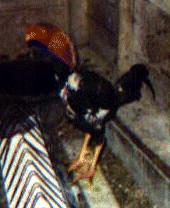
Saipan Cock
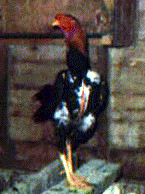
Saipan Cock
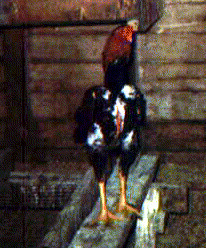
Saipan Cock