Chicken Issue
National Geographic Magazine
Chicken Edition
The April 1927 issue featured two articles, "Fowls of the Old and New World" and "America's Debt to the Hen," which introduced the world to the science of poultry farming. Subscribers were treated to numerous black and white photos and 15 pages of color paintings of unique chicken breeds.
As you may know, National Geographic was instrumental in advancing color photography and printing. While they were not the inventors of the technology, the demand they created pushed it forward. In 1914, they printed their first color photograph. At the time, printing color images required either the Autochrome process which captured color images directly or hand-coloring black-and-white photos before sending them to the printer for four-color process reproduction.
The Autochrome process required significant light, resulting in shutter speeds of several seconds. This was impractical for chickens, which would not stand still for that long. To solve this, editors commissioned paintings and photographed those using the Autochrome process which is how the original color "plates" of the 1927 issue was illustrated.
In the mid-1990s, I discovered a September 1948 issue of the magazine featuring an article on "Easter Egg Chickens," which was my introduction to Araucanas, Ameraucanas, and Easter Egg chickens. That issue referenced the 1927 edition, which I later purchased from a fellow member of the Araucana Club of America.
I recognized the value of that 1927 issue and contacted National Geographic for permission to reproduce it on the DOMBIRD website. They denied my request. However, thanks to the magic of copyright expiration, I am now pleased to share it with you nearly 30 years later.
My version of the issue differs from the original, which was packed with black-and-white photos alongside those 15 color plates. I have converted every one of those black-and-white images into full color. National Geographic didn't print their own "all-color" issues until 1962.
Still, its a bit surreal when you look at an issue this old. Because the photos were originally taken almost 100 years ago, none of the people in them are still with us. The youngest person was a baby who would be about 100 years old today. The, now color, photographs tend to make you forget that fact.
After I finished scanning and colorizing the articles presented here, I learned of a pre-existing copy of the issue that was posted online by the Internet Archive. Theirs is a scanned copy of a microfilmed copy. In short, it sucks. Even the 15 pages of color are also in black and white. My version was scanned from an original issue of the magazine so the quality is better by orders of magnitude. I omitted the other articles in the issue that had nothing to do with chickens. This was primarily to keep the size down, but also some of the photos in those extra articles are not suitable for this web site which is frequented by children. If you insist on viewing the full version and don't have a problem with the light-gray on lighter-gray text, then you should look for Volume 51, Number 4.
Go ahead and download the issue for free. I hope you enjoy it. Click the magazine cover below to download it.
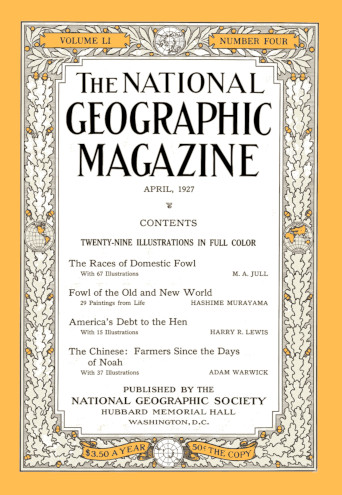
Click to Download the 1927 Issue
One final warning about the content. The way people talked and the words they used 100 years ago is different from today. As such, some sensitive readers might be offended by certain words. However, more than likely, you might find a word you have never heard of before. In the text, I found the word "perquisite". At first, I thought it was a typo meaning "prerequisite" instead, but no, its a real word, a word that I had never heard of before.